

Key Takeaways
- Percuplasty repositions the first metatarsal through a controlled bone cut and small incisions.
- Lapiplasty realigns the metatarsal and fuses the first tarsometatarsal joint, not the big toe joint.
- Examination, X-rays, symptoms, and individual health help guide procedure selection.
- Both procedures require individualized recovery instructions and carry surgical risks.
A painful bunion can make shoes uncomfortable and interfere with walking or exercise. When footwear changes, padding, and other nonsurgical treatments no longer provide enough relief, surgery may be considered.
At Vertex Podiatry, Dr. Guy Golan, DPM offers Percuplasty and Lapiplasty as surgical options. These procedures use different approaches, and choosing between them requires an examination, X-rays, and a discussion of your symptoms and goals.
What is Percuplasty?
Percuplasty is a minimally invasive bunion correction system. Through small incisions, the surgeon makes a controlled cut in the first metatarsal bone, repositions it to improve alignment, and secures the correction with screws.
The approach allows correction through small openings, but it still involves bone surgery. Small incisions do not eliminate the need for healing, postoperative protection, or follow-up care.
What is Lapiplasty?
Lapiplasty is a system used to realign the first metatarsal in three dimensions and fuse the first tarsometatarsal joint, located farther back in the foot.
This is not the big toe joint. The procedure stabilizes the corrected position while the fusion heals.
Lapiplasty may be considered when the examination and X-rays support correction at that joint. It is not automatically necessary for every bunion.
How are they different?
| Feature | Percuplasty | Lapiplasty |
|---|---|---|
| Main approach | Repositions the metatarsal through a controlled bone cut | Realigns the metatarsal through correction and fusion at the first tarsometatarsal joint |
| Important distinction | The bunion correction itself does not involve fusion of that joint | Fusion of that joint is part of the correction |
| Procedure selection | Based on deformity, joint condition, and individual needs | Based on deformity, joint condition, and individual needs |
| Recovery | Requires individualized protection and activity instructions | Requires individualized protection and activity instructions |
Neither procedure is the right choice for everyone. Incision size alone should not determine which operation is selected.
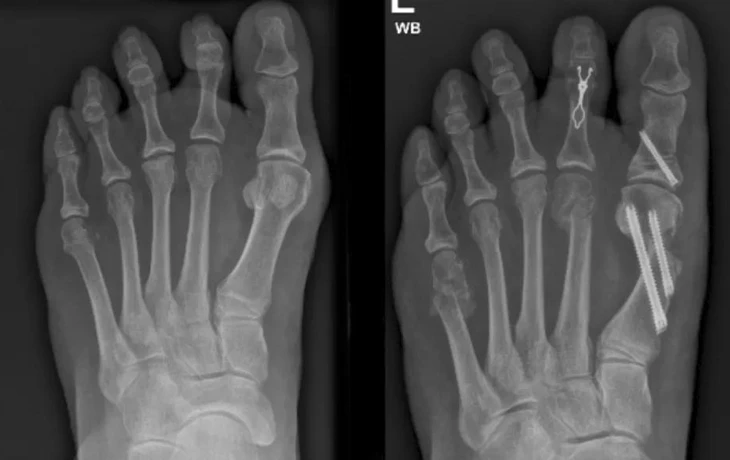
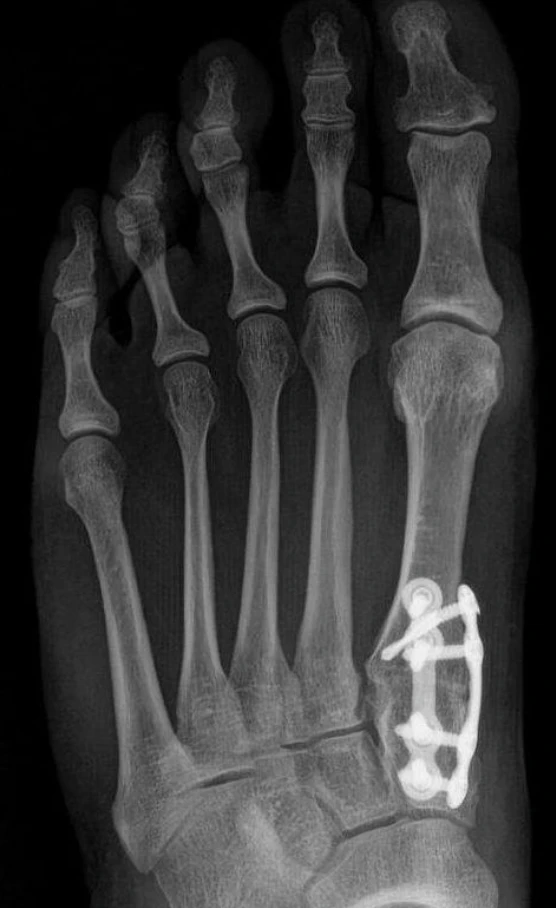
Bunion surgery X-ray examples
These X-rays illustrate changes in bone alignment and the appearance of surgical hardware. The images alone do not establish which branded system was used or what procedure is appropriate for another patient.
When should you consider surgery?
Surgery may be discussed when bunion pain continues despite appropriate nonsurgical care, limits daily activities, or makes suitable footwear difficult to tolerate.
The decision also considers joint arthritis, alignment, circulation, nerve function, bone health, and other medical conditions. A bunion's appearance alone does not establish a need for surgery. Read more about bunion evaluation and treatment and nonsurgical bunion treatment options.
What should you expect during recovery?
Your postoperative plan depends on the procedure performed, any additional corrections, and your healing progress. You may need a protective shoe or boot, restrictions on weight-bearing, and follow-up X-rays.
Do not assume that either procedure permits immediate unrestricted walking. Return to work, driving, exercise, and regular shoes should follow your surgeon's instructions.
Both procedures carry risks, including infection, nerve irritation, stiffness, persistent pain, recurrence, hardware irritation, and problems with bone healing. Lapiplasty also involves the risk that the intended fusion does not heal.
Explore your options at Vertex Podiatry
If bunion pain is affecting your daily life, schedule a bunion evaluation online or call (614) 328-5561. Our Grandview Heights office serves Columbus, Upper Arlington, and surrounding communities. Dr. Golan can explain whether nonsurgical care, Percuplasty, Lapiplasty, or another approach fits your needs. Consultations are available in English and Spanish.
This article provides general education, not a diagnosis or a personal treatment recommendation.
Procedure information
Manufacturer descriptions: Percuplasty procedure information and Lapiplasty procedure information. Manufacturer information describes the systems; it does not guarantee an individual outcome.
This article is for educational purposes only and does not constitute medical advice. Always consult a qualified podiatric physician for diagnosis and treatment of foot and ankle conditions.

Founder, Vertex Podiatry · Grandview Heights, Columbus, OH
Dr. Golan completed a three-year podiatric surgical residency at a Level 1 Trauma Center and brings advanced training in minimally invasive surgery, regenerative medicine, and comprehensive foot and ankle care to patients in Columbus and Central Ohio. All articles are reviewed for clinical accuracy before publication.
Meet Dr. GolanReady to Get Expert Care?
Schedule an appointment at Vertex Podiatry in Grandview Heights, Columbus.


